

We’ve been bombarded with so much complicated and conflicting information about cholesterol that it makes the head spin. But before you throw up your hands in disgust and dig into a four-egg-bacon-cheese-omelet with fries on the side, read this. It’s important to understand how cholesterol and fat affect your health.
If cholesterol is so bad for you, how can there be a “good” cholesterol? What’s the difference between saturated, monounsaturated and polyunsaturated fat? What are triglycerides and trans fatty acids? How do different types of fat impact cholesterol levels? It takes a bit of patience to understand all the ins and outs of fat metabolism but the basic principle is simple: Too much cholesterol in the blood is among the top four risk factors for heart disease (the other three are smoking, high blood pressure and lack of exercise). Excess blood cholesterol can cause arteries to become clogged and, in turn, may lead to a heart attack or stroke.
Americans have received the cholesterol message loud and clear. Our national obsession to cut back has resulted in a 20 percent drop in the consumption of cholesterol since the mid-1970s. But fending off heart disease is not that simple. Why? Other types of fats influence cholesterol levels and they, too, need to be monitored in the diet. The biggest trouble-maker in the fight against elevated blood cholesterol and heart disease is saturated fat.
What is Cholesterol?
Cholesterol is a lipid, a soft, fat-like substance that, in reasonable quantities, is critical to good health. It is a component of cell membranes, is found in all body tissues, and is converted into various hormones. Cholesterol comes from two sources: it’s produced by the body, mainly in the liver. And it’s found in food, especially animal products such as meat, poultry, seafood, dairy products and eggs.
What is Good & Bad Cholesterol?
The answer to this question will become clear once you understand how cholesterol is shuttled around in the body. Like other nutrients, cholesterol has to travel to the body’s cells through the blood. However, since it is not water soluble, the substance must be transported to organs by special carriers called lipoproteins. There are several kinds of lipoproteins, but low density lipoprotein (LDL) and high density lipoprotein (HDL) are the ones that get all the press when it comes to cholesterol.
LDL is the major cholesterol carrier in the blood. It has been dubbed “bad” because it slowly builds up in the walls of arteries. Together with other substances, LDL-cholesterol can form plaque (a thick, hard deposit) that restricts the flow of blood through the arteries and can result in a heart attack or stroke.
| Studies have shown that, in adults with high blood cholesterol, for each one percent reduction in total cholesterol levels, there is a two percent reduction in the number of heart attacks. In other words, if you have been diagnosed with high cholesterol, reducing your cholesterol level by 15 percent, could drop your risk of coronary heart disease by 30 percent. |
On the other hand, HDL carries about one-third to one-fourth of blood cholesterol. HDL cholesterol is touted as “good” because it not only carries cholesterol away from the arteries and back to the liver, where it’s removed from the body, but it sweeps away the cholesterol dumped by LDL.
What Role Do Other Fats Play?
It may surprise you to find out that dietary cholesterol has only a modest impact on blood cholesterol levels for most of the population. When the body is working efficiently, the liver regulates itself to keep potentially harmful LDL-cholesterol from building up in the blood. And when we eat foods high in cholesterol, the small intestine absorbs less of it and the liver reduces its production of cholesterol. People called “cholesterol responders” have faulty cholesterol adjustment systems and their blood cholesterol is high, but this is quite rare.
If this is true, you’re probably wondering, what’s all the fuss about? Well, cholesterol has accomplices in gumming up the arteries. Enter the role of fats we eat: saturated, polyunsaturated and monounsaturated. These three types of fat differ in their impact on cholesterol levels.
Monounsaturated and polyunsaturated fats can help lower cholesterol levels. Monounsaturated fats are found in greatest amounts in food from plants, including olive, peanut and canola oil. When substituted for saturated fat, monounsaturated fat helps lower LDL’s while leaving HDL’s unchanged. Polyunsaturated fats are found in foods from plants, including safflower, sunflower, corn and soybean oils. When used instead of saturated fats, polyunsaturated fats tend to lower LDL’s but they lower HDL’s as well.
Saturated fats are found mainly in foods from animals such as meat, poultry, and whole-milk dairy products like cream, milk, ice cream, and cheese. Saturated fat is also found in butter, lard and coconut, palm kernel, and palm oils. Saturated fats have the dubious distinction of raising cholesterol levels far more than anything else we eat. That’s why, if you’re trying to lower your blood cholesterol level through diet, you must curb the total amount of fat you eat, especially saturated fat.
In addition, new evidence suggests that trans fats (formed when liquid vegetable oils are processed to make hard or semisoft table spreads and cooking fats) may be even worse for your heart than saturated fats. In an on-going study of 80,000 nurses, researchers found that the chance of suffering a heart attack was 53 percent higher for the women who consumed the largest amounts of trans fats than for those who consumed the least amount of them. But the women in the group with the largest consumption of total fat (46 percent of calories) had no greater risk of heart attack than those in the group with the lowest consumption of total fat (29 percent of calories). Does this mean as long as we eat the right fats we can eat as much as we like? Not at all. This is preliminary research, and health experts still underscore the importance of moderation when it comes to fat intake. A diet high in fat often leads to being over weight, which can have many negative effects on health, including increasing the risk of heart disease and diabetes.
Does Dietary Cholesterol Matter at All?
The main problem with cholesterol-rich foods is that they also tend to be high in dietary fat, particularly saturated fat. However, there are some foods that contain lots of cholesterol but little saturated fat. These include egg yolks, shellfish, such as shrimp and squid, and liver and other organ meats. If your cholesterol levels are well within the desirable range, you don’t have to worry much about eating these foods. But be sensible. It’s wise to follow the current public health recommendations, which include eating no more than three or four egg yolks per week, including those used in cooking, and only modest amounts of other animal foods.
How Vigilant Should Senior Citizens be About Cholesterol?
Blood-cholesterol levels have a smaller impact on coronary risk in older people, so it’s less important for them to watch cholesterol and saturated fat in foods. A greater concern for older people is to eat an adequate diet. One way to help insure this is by eating eggs, which are highly nutritious and inexpensive.
Can Drinking Alcohol Be Heart Healthy?
You may have heard that drinking one or two alcoholic beverages a day is linked to a lower incidence of heart disease in some studies. But you need to weigh certain risks before uncorking that bottle of wine. American Heart Association (AHA) warns that before continuing or starting to drink, you should check with your doctor. Alcohol can interact dangerously with certain medications, and it can worsen medical conditions such as liver disease, pancreatitis and uncontrolled hypertension. Heavy drinkers are at increased risk of cancers of the oral cavity, larynx and esophagus. As for breast cancer: Harvard researchers who analyzed six studies found that the risk of developing that disease rises 9 percent for every ten grams of alcohol a woman drinks per day. Women who average four glasses of wine daily have a 40 percent greater risk than nondrinkers. Pregnant women and people with a personal or family history of alcoholism should avoid alcohol.
Are Fish Capsules Beneficial?
Fish are rich in omega-3 fatty acids, a form of polyunsaturated fat that is different from the omega-6 fatty acids found in most vegetable oils. Omega-3 fatty acids lower blood levels of triglycerides and very low-density lipoproteins (VLDL). The AHA recommends eating fish regularly but thinks more studies need to be done to confirm any protective link fish oils have against heart disease. The use of fish oil capsules to lower cholesterol levels is not recommended.
Can Antioxidants Help?
A recent study at the University of Maryland Medical Center found that large doses of two antioxidants, vitamins C and E, may decrease the heart-disease risk posed by a high-fat diet. In the study, published in the Journal of the American Medical Association, 20 subjects ate a meal of Egg McMuffins and Sausage McMuffins with slabs of fried hash browns. After the fat-packed breakfast, they had impaired blood vessel function that lasted up to four hours. No such impairment was found when they swallowed 20 times the recommended daily dosage of vitamins C and E immediately before eating the same meal on a second occasion.
Antioxidants are vitamins that protect cells from oxidation. The oxidation process is familiar: it causes metal to rust, fruit to turn brown and oils to go rancid. Inside the body, oxidation can severely damage cells and allow diseases to get a foothold. Destructive oxygen byproducts, called free radicals, are produced both in our bodies when oxygen is metabolized and in the environment by factors like cigarette smoke and polluted air. Antioxidants seem to deactivate free radicals, thus protecting cells from damage.
Before rushing to the nearest vitamin store, keep in mind that the Maryland study was small and preliminary. Researchers have yet to determine whether there are any long-term benefits–or dangers–related to using such huge vitamin doses. Right now, the best thing is to enjoy foods high in vitamins C and E and continue to avoid a high-fat diet. Vitamin C is found in green and red peppers, collard greens, broccoli, spinach, tomatoes, potatoes, strawberries, oranges and other citrus fruits. Vitamin E is in vegetable oils, margarine, vegetable shortening, nuts, wheat germ and green leafy vegetables.
What Is Considered High Blood Cholesterol?
Your blood cholesterol levels are determined by your genetic makeup and by the amount of fat in your diet. To check cholesterol, a doctor will take a blood sample and measure the lipids in milligrams per deciliter (mg/dl).
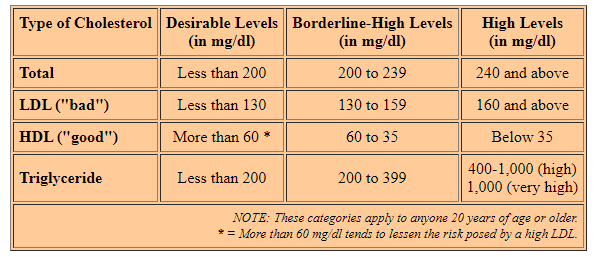
According to the AHA, approximately 52 percent of adult Americans have Borderline-High blood cholesterol levels and 20 percent have High cholesterol levels (see chart). Though a blood cholesterol level of 240 mg/dl or greater is considered High, any level above 200 mg/dl increases your risk for heart disease. If your blood cholesterol is in the High category, you have more than twice the risk of someone whose cholesterol is 200 mg/dl.
But total blood cholesterol is not enough to determine your risk. One out of every five heart attack victims has a total cholesterol level in the normal range, below 200 mg/dl. To really zero in on your risk for heart disease, you need to have a lipid analysis to determine your LDL, HDL and triglyceride levels.
Having less than 35 mg/dl of HDL-cholesterol is considered a risk factor for heart disease even when total cholesterol and LDL-cholesterol levels are normal. That is because you have less of this “good” cholesterol working in your system. Similarly, your LDL-cholesterol level greatly affects your risk of heart attack. In fact, LDL-cholesterol is a better predictor of heart attack risk than total blood cholesterol. When it comes to LDL-cholesterol levels, the lower your level the lower your risk.
In addition to cholesterol, researchers have found that fat-like substances called triglycerides can increase the risk of heart disease by contributing to fatty deposits in the arteries. We get triglycerides primarily from the fat in our diet, but luckily, these lipids are much more responsive than cholesterol to lifestyle changes such as exercising and eating a low-fat diet.
Lowering your high blood cholesterol level will slow fatty buildup in the walls of the arteries and reduce your risk of a heart attack. Factors that will influence blood cholesterol levels include eating a low-fat diet, replacing saturated fat with unsaturated fat, shedding pounds if you’re overweight, exercising regularly, and stopping smoking.
How Does Cholesterol Lead to Heart Disease?
| When high blood cholesterol is combined with other major risk factors, the chance that you’ll suffer from heart disease increases even further. For example, if your cholesterol level is in the High category and your blood pressure is elevated, your risk for heart disease increases six times. If you also smoke, your risk increases more than twentyfold. |
Most heart disease is caused by atherosclerosis, which occurs when cholesterol, fat, and other substances build up in the walls of the arteries that supply blood to the heart. These deposits, called plaque, narrow the arteries and can slow down or block the flow of blood. One of the most important functions of blood is to carry a constant supply of life-giving oxygen to the heart. Without oxygen, heart muscle tissues are gradually destroyed, resulting in chest pain (angina), a heart attack (myocardial infarction), or even death. In the same manner, a buildup in the arteries supplying blood to the brain can cause a stroke. Atherosclerosis is a slow progressive disease that may start very early in life yet might not show symptoms for many years.
What You Can Do
Here are the current AHA recommendations:
- If you are a healthy adult over 20, test your blood cholesterol levels at least once every five years.
- Eat no more than 300 milligrams of cholesterol a day. One egg yolk has about 213 milligrams of cholesterol. Egg whites, on the other hand, have no cholesterol or fat and are a great source of protein. You can substitute two egg whites for each egg yolk in many recipes that call for eggs.
- Limit your total fat intake to less than 30 percent of calories, with less than 10 percent coming from saturated fats. You can accomplish this by:
- Choosing more fruits, vegetables and whole grains instead of fatty meats and bakery goods.
- Eating fish, poultry without skin and lean meats instead of fatty ones.
- Consuming low-fat or skim milk dairy products instead of whole milk dairy products.
How Can You Lower Your Cholesterol?
If your doctor has suggested that you lower your cholesterol levels, try to whittle them down by exercising regularly, eating a low-fat diet, and stopping smoking. If that doesn’t work and your doctor urges you to take medication, discuss the various drugs that are available. One option may be to take niacin, which can raise HDL (good cholesterol) and reduce LDL (bad cholesterol). Niacin is not appropriate for everyone who needs to lower cholesterol levels, but for those who are good candidates, it may give the best results at the lowest cost.
Another option may be to take one of a group of drugs called statins (brand names include Lipitor and Zocor), which inhibit the body’s production of cholesterol. Statins have been around for over a decade, but they are getting increasingly more recognition for their ability to reduce the number of first heart attacks among people with high cholesterol and to lower deaths among heart-attack survivors. Some researchers think this class of drug could also reduce the risk of dying from a heart attack among people with normal cholesterol levels and no sign of cardiovascular disease. As for drawbacks: statins are expensive and, in rare instances, cause liver damage. Patients taking them need to have periodic blood tests to check their liver function. Fatigue is another possible side effect.
Keep in mind that cholesterol is not a matter of the lower the better. Studies suggest that while people with low cholesterol (less than 160 mg/dl) are at less of a risk for coronary heart disease, they are apparently more likely to die from noncardiac causes, ranging from cancer to physical trauma. So if you have normal cholesterol levels (between 160 and 200 mg/dl) you shouldn’t get over-zealous and try to drive it down even further.
Fats and oils are mixtures of fatty acids. Each one is designated saturated, monounsaturated or polyunsaturated, depending on what type of fatty acids is predominant in that one.
- Saturated Fatty Acids have all the hydrogen the carbon atoms can hold. The more saturated fatty acids in a fat, the harder it is at room temperature and, in general, the more damaging it is to your health. Saturated fats, abundant in meat, dairy products, palm and coconut oils, tend to increase “bad” LDL-cholesterol, thus raising the risk of heart disease.
- Unsaturated Fatty Acids have at least one unsaturated bond–that is, at least one place that hydrogen can be added to the molecule. There are two common types:
- Monounsaturated Fatty Acids have only one unsaturated bond. Monounsaturated oils are liquid at room temperature but start to solidify when chilled. Monounsaturated fatty acids, found in olive, peanut, and canola oils, seem to lower LDL-cholesterol without lowering HDL-cholesterol.
- Polyunsaturated Fatty Acids have more than one unsaturated bond. And polyunsaturated oils (corn, soybean, safflower, sunflower) are liquid at room temperature and in the refrigerator. They easily combine with oxygen in the air to become rancid. Polyunsaturated fatty acids help to lower LDL-cholesterol, but may also reduce the “good” HDL-cholesterol.
- Triglycerides are a type of blood fat derived directly from the fatty foods fats we eat or made by the body. They are important for transporting and storing fat in the body, but they may also play a role in cardiovascular problems. About half the people who get heart disease have low or normal cholesterol levels. For this population, experts suspect that high triglyceride levels may be the culprit. Excess triglycerides also appear to be associated with a greater risk of developing diabetes, which itself increases heart disease risk.
- Trans Fatty Acids are formed when unsaturated fatty acids are subjected to a process called hydrogenation, which changes the structure of the unsaturated fatty acid molecules and makes them similar to saturated fatty acids. Since liquid oils spoil easily, manufacturers use hydrogenated oils in margarine, fast food, and processed food to keep their products fresher longer and give them a desirable consistency. But the so-called trans fats that are produced by hydrogenating oils increase the risk of a heart attack by raising blood levels of artery-clogging LDL cholesterol and triglycerides and lowering levels of HDL cholesterol. To avoid trans fatty acids, use tub margarines or liquid vegetable oils that are high in unsaturated fat instead of hydrogenated vegetable shortening, and cut down on commercially prepared and processed foods, including cookies, cakes and crackers.
Getting an accurate cholesterol reading can be tricky. The tests themselves–particularly those done outside a doctor’s office, laboratory, or other medical setting–may be imprecise. But even with the best testing equipment, blood sample results can vary nearly 20 percent depending on the time of day, what you’ve eaten, and whether you’ve exercised recently. Here’s how to maximize the chance of getting accurate readings:
- Ask if the laboratory processing your blood conforms to standards set by the Centers for Disease Control (CDC). If it doesn’t, try to use a different lab.
- Remind your doctor about any medications you’re taking. Many drugs, such as blood-pressure medications and birth-control pills, can affect cholesterol levels.
- Sit calmly for ten minutes before your blood is drawn. Your posture and any abrupt changes in position can affect the results.
- If you’re having blood drawn from your arm, make sure the tourniquet stays on for no more than one minute. Any longer may boost cholesterol readings by as much as 15 percent.
- In the 12 hours prior to your test consume only water. Avoid strenuous exercise for 24 hours before testing.
- Confirm any abnormal or borderline readings by taking a second test and averaging the findings. If the lower reading of total cholesterol is more than 14 percent below the higher reading, have a third test and average the results of all three. Do the same if the lower reading for HDL, LDL or triglycerides is more than 24 percent below the higher reading. Tests should be done at least one week apart, but within two months.